
Recent History of Women at Asbury (2001-2026): Slow Growth and Stagnation
The year 2000 found Asbury Theological Seminary nearing the end of a period of rapid growth in women students and women faculty. By 2005 Asbury would hit its high-water mark of thirteen women faculty members. After 2000, the Seminary appears to have focused briefly on expanding to include greater ethnic diversity among its women faculty. Rev. Dr. Joy Moore has noted that the provost at the time, Joel Green, was under pressure from both the student body and accreditation bodies about the low number of ethnic minorities represented on the campus.22 As a result, three women moved onto the faculty in 2002 and 2003. Dr. Meesaeng Lee Choi (2002-2023) would become the first Asian woman faculty member. Her area of specialty was in Church History, particularly the Holiness Movement in Korea. Dr. Zaida Maldonado Perez (2002-2017) would become the first Hispanic woman faculty member, also teaching in Church History, but rising in the administration to become the Dean of the School of Urban Ministries at Asbury’s Florida campus in Orlando. Dr. Joy Moore (2003-2006) would be the first African American woman faculty member, teaching in the field of Preaching. Later, Dr. Ann K. Gatobu (2008-2016) would become the first African woman faculty member. She taught in counseling and would rise to lead the School of Counseling for several years. In addition, Dr. Beverly Johnson-Miller would join Discipleship and Formation area from 2002 to 2020, with a special interest in ministry to the elderly.
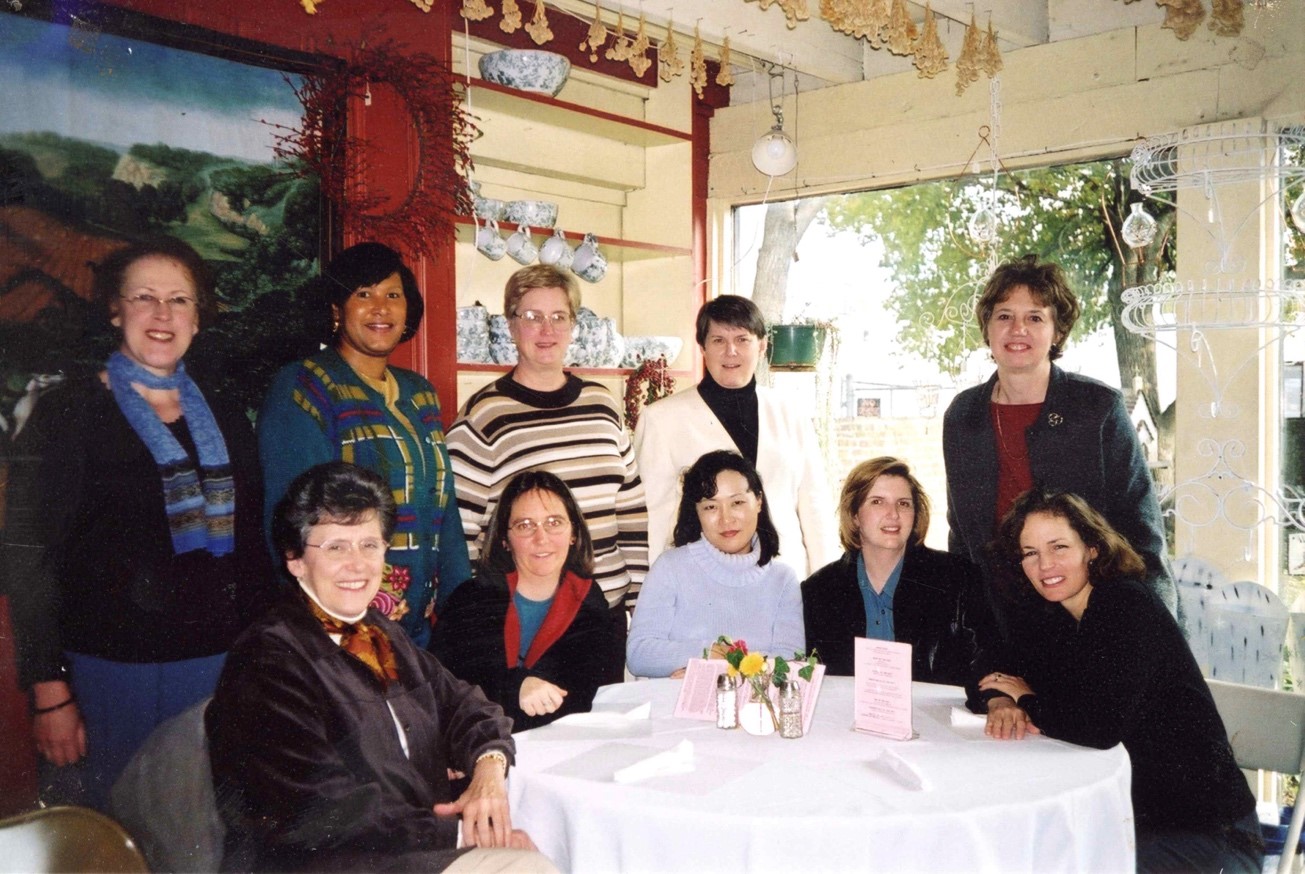
The women faculty of Asbury Theological Seminary near their high point in 2003 at a birthday celebration for Ruth Anne Reese.
Front row (L to R): Catherine Stonehouse, Ruth Anne Reese, Meesaeng Choi, Stacy Minger, Sandra Richter.
Back row (L to R): Eunice Irwin, Joy Moore, Leslie Andrews, Mary Fisher, Christine Pohl.
Photo taken by Toddy Holeman.
(Image used courtesy of Ruth Anne Reese).
From 2000 to about 2017 the number of women students stayed roughly at the same level, a fact recognized by Lisa Weaver Swartz in her book, Stained Glass Ceilings: How Evangelicals Do Gender and Practice Power,
Asbury, however has struggled to achieve the demographic equity it prescribes. At the time of my research, women composed only 34 percent of the entire student population of just over 1,600- a percentage that had remained virtually unchanged throughout the previous ten years. On faculty, the percentage of women was even lower at less than 16 percent. These patterns mirror the gender inequality within American Conservative Protestantism.23
It is important to reflect on possible reasons for the growth to stop, even while the number of women faculty remained strong. Evelyn Kuttler, the Board member most responsible for the initial growth in women faculty and students, left the Board in 2003. It is possible that this led to a decreased commitment to advance women faculty at this time, or perhaps a feeling that the goals had been achieved and other projects needed to be advanced more urgently.
The active program for fostering women in ministry, which has begun in the 1980s faced its own organizational challenges in the early 2000s. In 1995, there was no overarching Office of Student Life, and so the Office of Women’s Ministries ran itself. In 1996, the Office of Student Life and Enrollment was created to house several different operations of the Seminary and Women’s Ministries was included as part of this office under the leadership of Robert Jones as the director. There were two women working in the area, Barbara Holsinger as the Director of Women’s Ministries and Margi Galloway as the Coordinator of Spouse Ministries (the clear assumption being that “spouses” were all women). In 1997, Barbara Holsinger stepped down into another position to allow Joy Moore to become the Director of Women and Ethnic Ministries.24 In 1999, Joy Moore became the Director of Student Life and Robert Jones became the Vice President of Enrollment. As this change occurred there was only one person listed under the Office of Women’s Ministries and that was Margi Galloway as the Director of Spouse Ministries. In 2000, the office became simply the Office of Spouse Ministries and by 2001 it became the Office of Spouse and Family Ministries. Joy Moore had transitioned to becoming a faculty member in Preaching and Anthony Shelton became the Director of Student Services. Thus, the original Office of Women’s Ministries vanished under the creation of the new Office of Student Services.
With the absence of an office committed to focusing on women in ministry, women’s chapels, forums for women in ministry, and similar projects disappeared on campus. Without increased pressure from within the Board, from the students, and from denominational authorities any focused energy on women in ministry evaporated. Without a clear and focused advocate for women on the board and in the administration, students likely assumed some form of gender equality had been achieved with the presence of 13 women on the faculty and 34% of the degree-seeking students being women.
Since 2017, the number of women degree-seeking students has gradually risen to around 40% of the entire student body in 2026. It is no longer a question of if Asbury Theological Seminary will reach gender equality in the student body, but when that will happen. The question of gender equality among the faculty remains an open question. There are currently only eight women on the faculty at Asbury Theological Seminary as of 2026:
Dr. Ruth Anne Reese (2000- ) remains as one of the youngest of the second generation, and her work as the Professor of New Testament in the School of Biblical Studies continues to inspire women students to enter the field which has often been the most resistant to women scholars.
Dr. Stacy Minger (2004- ) came to Asbury as a student in the 1980s, and while she was one of the few who worked on the M.Div. degree, she became influenced by Cathy Stonehouse and Leslie Andrews, who both provided an “anchor” for her as she joined the faculty. When Stacy became a faculty member in the field of Preaching, she continued to develop a strong relationship with both Cathy and Leslie as mentors. Dr. Minger is the current Associate Professor of Preaching.
In a similar way, Dr. Ellen Marmon (2005- ) came to Asbury as a student in the late 1980s while also working in a local church in Lexington. Since she was interested in the field of Christian Education, she also developed a strong mentor relationship with Cathy Stonehouse, who even encouraged Ellen to go on for a doctorate. Dr. Marmon currently serves as the Professor of Christian Discipleship.
Dr. A. Sue Russell (2014- ) the current Professor of Mission and Contextual Studies came to Asbury Theological Seminary with a wealth of experience after serving for 17 years with Wycliffe Bible Translators in Southeast Asia. She also served as the Associate Professor of Anthropology and the Chair of the Department of Anthropology at Biola University.
Dr. Christine Johnson (2014- ) initially worked at Asbury Theological Seminary as the registrar and then as Associate Provost of Academic Affairs. She is currently the Assistant Professor of Historical Theology and Wesleyan Studies.
Dr. Maria Russell Kenney (2018- ) comes from a background of involvement with various forms of ministry, including: campus ministry, low-income advocacy in Appalachia, working with emotionally disturbed adolescents, international medical relief work, pastoral ministry and local mission efforts. She came as a student, after meeting Christine Pohl in 1994. Pohl influenced her decision to comes as a student, where they became friends and collegues. She is currently the Assistant Professor of Christian Ethics and continues to be influenced by the work of Christine Pohl.
Dr. Janet Dean (2022- ) the current Professor of Pastoral Counseling Education came to Asbury Theological Seminary in 1992, just as the MA in Counseling was beginning. She developed a great respect for the women on the faculty, especially Catherine Stonehouse, Christine Pohl, and Toddy Holeman, but also with many of the male faculty, such as David Bauer, Harold Burgess, Fred Van Tatenhove, and David McKenna. She also completed an M.Div. at the Seminary and worked as a staff member in the library before teaching at Asbury College, prior to coming on the faculty in 2022.
With 30 years of experience in community mental health counseling, Dr. Jacqueline Smith (2022- ) the current Dean of the School of Counseling has been active in the field, with a special interest in counseling ethnic/racial minority groups. She is one of the most recent women to join a new generation of women at Asbury Theological Seminary. During the same period, Dr. Leanne Dzubinski (2023-2024) served briefly as a professor in leadership.
Asbury Theological Seminary has a strong theological history of women in ministry and leadership. Rooted in the Holiness tradition, which saw women as equally gifted and empowered by the Holy Spirit for ministry, this led to an early rise of women faculty in 1947-1949. In my interviews, some have suggested that the decline in the presence of women in the 1950s-1970s might have been due to a desire for Holiness groups to become more accepted in academia and ministry among mainline denominations. It may also have been due to the cultural dynamics of the post-war era in the United States as women left the workplaces they filled during the war years and returned to traditional roles in the home. The presence of women at the Seminary during these years tends to focus on roles as auditors25, Christian music26, or religious education degrees.
The dramatic growth of women students and women faculty from 1985 to 2000 is clearly due to a focused attention on the issue of women in ministry. The presence of a Trustee committed to change, along with the voices of women students led to a focused Office of Women’s Concerns and ultimately the intentional hiring of women faculty. The presence of a growing number of women on the faculty led to a growing number of women students, who were also supported and empowered by an office founded by the administration. These combined factors led to a rapid growth in the presence of women students and an acceptance of the idea of women in ministry. After 2000, the loss of an advocate in the Board of Trustees and the loss of a specific office to advocate for women in ministry has led to a drop in the intentional hiring of women faculty and thus a dramatic slowdown in the recruitment of women students. This entire history comes together to raise some important lessons Asbury Theological Seminary needs to consider for the future of women at the Seminary.
Lessons Learned from the History of Women at Asbury Theological Seminary
- Role models matter. While a few people might be self-motivated to overcome obstacles, most people need to see people in key roles to envision themselves in similar positions in the future. With role models comes a belief that the same result is a real possibility, and this encourages students to seek those dreams made real through role models.
- Growth in women students is a result of investing in women faculty. When women faculty were at their highest levels or growing, the number of degree-seeking women students increased accordingly.
- Having a specialized focus on women pays off, but it needs to be multidirectional (faculty, students, and Board of Trustees all committed to the same goals). If only one side is pushing for change, the institution is more likely to fail. When all stake-holders are involved there is a better chance at successful change.
- Provide avenues for public focus. The presence of women’s chapels, special women’s speakers, and an Office of Women’s Concerns helped project an institutional concern which reached beyond a simple public statement of affirmation.
- Diversity in subject fields is necessary. In the academic environment, just having token representatives in a few less important roles is not enough. The second generation of women faculty was most successful because they were distributed in all different fields of study and in institutional leadership across the Seminary, not just in traditional areas like Christian Education or Music programs.
- Allowing time for community formation is critical. The early success of women was tied to organizational groups like Chi Alpha and the Seminary Dames, and the second generation of women faculty made it a point to hold community events, retreats, and dinners to support each other. This creates a network of support which helps promote healthy growth.
- Institutional support is critical. The key force for change came from people like Bettie Morrison and Evelyn Kuttler who used their roles on the Board of Trustees to help push the cause of women into the mindset of the institution. While faculty and students have keys roles to play, it is difficult to change an institution which does not have internal advocates in positions of administrative power.
Conclusion
The history of women at Asbury Theological Seminary demonstrates how history can help inform current practice. Many of the women from the first generation of women faculty have been forgotten, and those from the second generation are rapidly falling out of the institutional memory as well. Asbury was built on a foundation which valued women as people who could also be filled with the Spirit and serve in ministry. That foundation, combined with an institutional commitment in the form of a Board of Trustee member, and students with a passion for ministry, led to the growth of the second generation of women faculty, which in turn resulted in a rapid growth of women students seeking degrees.
As institutional commitment to the cause of supporting women in ministry cooled, the number of women faculty dropped, the Office of Women’s Concerns vanished into the Office of Student Life, special events and speakers oriented on women in ministry stopped, and the growth of women students stagnated. It is hoped that an historical study such as this, might provide the answers on how to turn this around in the present as well as reflect on the institution’s past.
Women Faculty of Asbury Theological Seminary
Note: This is the most current list as of Spring 2026 at the end of the first year of the Watson Administration. It was created from several older lists (including Fraley’s An Historical Survey of Asbury Theological Seminary 1923-1949) compared with Seminary directories, Seminarians, Who’s Who directories, and archival records from the provost office. Recent information was also checked through the provost office, Employee Services, and the administrative assistant of the Board of Trustees. It is still likely that some people are missing from this list since the concept of faculty changed over time. It is also possible some dates may be slightly off. From 1923-1937, the Seminary in essence shared faculty with Asbury College, so there were no clear lines. Even after 1937 until the early 1940s some faculty were shared without being clearly listed as being part of Asbury Theological Seminary. From 1945 till about 1982 professional librarians had formal faculty status. It is likely at other times various administrative positions also were treated as faculty, but such positions are not usually referred to as faculty in official publications. From 1945 till 2002 (and possibly longer) various people were hired to teach classes as visiting professors, visiting lecturers, or instructors, but were not given full faculty status. We have included as many of these as possible based on the records previously mentioned, but it is highly likely that some have been missed in the process. The list of full professors is complete and well documented, as are the Librarians with Faculty Status and the women on the Board of Trustees.
Faculty Shared with Asbury College
Daisy Dean Gray (1923-1925; 1927-1938) Professor of Speech
Mary Elizabeth Corley (1932-1934) Assistant Professor of Speech
Hildreth Marie Cross (1934-1935) Professor of Philosophy and Psychology
Mildred L. Stanhope (1935-1938) Instructor of Missions and Spanish
Ruth Little (1937-1938) Teacher of Speech
Mary Chamberlain (1939-1940) Professor of English Bible
Full Professors at Asbury Theological Seminary
Ada B. Carroll (1937-1938; 1943-1962) Professor of Music and Speech
Gaile J. Morris (1937-1948) Professor of Hebrew and Old Testament
Ruth E. Nussey (1951-1953) Associate Professor of Church Music
Elizabeth Batten Edwards (1958-1960) Assistant Professor of Church Music (1960-1968 Visiting Professor)
Catherine Stonehouse (1987-2011) Professor of Christian Education
Christine Pohl (1989-2018) Professor of Church and Society
Leslie Alice Andrews (1990-2013) Director of the D. Min. Program, Vice Provost
Eunice L. Irwin (1994-2013) Professor of Mission and Contextual Theology
Mary Fisher (1994-2003) Assistant Professor of Biblical Theology
Virginia Todd Holeman (1995-2020) Professor of Counseling
Ruth Anne Reese (2000- ) Professor of New Testament
Sandra Richter (2000-2008) Professor of Old Testament
Helen D. Musick (2000-2001) Instructor in Youth Ministry
Meesaeng Lee Choi (2002-2023) Professor of Church History
Beverly Johnson-Miller (2002-2020) Professor of Transformative Education and Aging
Zaida Maldonado Perez (2002-2017) Professor of Church History and Theology (Florida Campus)
Joy Moore (2003-2006) Assistant Professor of Preaching
Stacy Minger (2004- ) Professor of Preaching
Ellen Marmon (2005- ) Professor of Christian Discipleship
Anne K. Gatobu (2008-2016) Professor of Pastoral Care and Counseling
Deb Colwill (2011- 2012) Assistant Professor of Leadership/ Director of Institutional Research and Evaluation
Sue Russell (2014-) Professor of Mission and Contextual Studies
Christine Johnson (2014-) Assistant Professor of Historical Theology
Maria Russell Kenney (2018-) Assistant Professor of Christian Ethics
Janet Dean (2022-) Professor of Pastoral Counseling Education
Jacqueline Smith (2022-) Associate Professor of Counselor Education and Dean of the School of Counseling
Leanne Dzubinski (2023-2024) Professor of Christian Leadership and Director of Beeson Center
Librarians with Faculty Status
Lena Barbara Nofcier (1945-1949) Librarian
Ollie Mae Williams (1946-1949) Library Cataloger
Susan A, Shultz (1949-1978) Librarian
Ruth A. Warnock (1949-1962) Library Cataloger
Marilyn Walker Morrison (1965-1971) Library Cataloger
Women on the Board of Trustees
Bettie Morrison (1931-1945)- Only woman to sign the original incorporation papers
Evelyn Kuttler (1977-2003)
Ann Kiemel Anderson (1979-1984)
Kathryn Chatlos Randle (1984-1993)
Gloria Brooks (1989-2014)
Kimberly Rupert (1993-1998)
Karen Thomas (1995-2024)- Chair of the Board (2022-2024)
Kay F. Radar (1998-2003)
Joan Krupa (2003-2023)- Chair of the Board (2011-2014)
Peggy Kirkpatrick (2005-2018)
Nancy Dumas Boortz (2007-2023)
Debra Blews (2009-2024)
June Edwards (2010-2014)
JoAnne Lyon (2014-2020)
Anna Jackson (2014-)
Amy Wasserbauer (2014-)
Helen Rhea Stumbo (2018-)- Chair of the Board (current)
Sherree Funk (2018-)
Cynthia James (2020-2022)
Stephanie Raglin (2020-)
Linda Adams (2020-2024)
Elaine Friedrich (2021-)
Jill Brue (2021-)
Visiting/ Short Term Lecturers without Full Faculty Status
Annie Kartozian (1945-1946) Professor of Chinese Language
Eva Gilger (1982-1983) Visiting Lecturer in Cultural Anthropology and Missions
Thelma Goold (1984-1988) Visiting Lecturer in Church in Society
Margaret Dunn (1984) Teaching Fellow in English Bible
Jo Anne Lyon (1985-1991) Visiting Lecturer in Women’s Studies
Sandra D. Wilson (1990-1991) Visiting Lecturer in Pastoral Counseling
Suzanne Coyle (1990-1991) Visiting Lecturer in Family Systems Theory
Deanna W. Jobst (1992-1995) Visiting Lecturer in Pastoral Ministry
Julie Joy (1997-1999) Visiting Lecturer in Pastoral Ministries
Music Instructors without Full Faculty Status
Margaret Therkelson (1984-1987) Visiting Lecturer in Music
Beatrice H. Holtz (1986-1988) Visiting Lecturer in Music
Virginia Bowles (1987-2002) Visiting Lecturer in Music
Bonnie Harstad (1988-1999) Visiting Lecturer in Music
Ulle Ritsbek (1992-1993) Visiting Instructor in Piano
Patricia J. Bracken (1992-1999) Visiting Instructor in Voice
Kristine B. Lyon (1995-1996) Visiting Instructor in Voice
Christian Education Instructors without Full Faculty Status
Verna M. Culver (1956-1966) Teaching Associate in Christian Education
Grace B. Ely (1959-1960) Assistant in Religious Education
Alice M. Kann (1963-1965) Assistant with Christian Education Fieldwork
Linda Rickman (1980-1987) Visiting Lecturer in Christian Education
Dorothy Braun (1982) Visiting Lecturer in Christian Education
Helen D. Musick (1986-1989) Visiting Lecturer in Christian Education/ Asst. Dean of Students
Phyllis Hail (1987-1989) Visiting Lecturer in Christian Education
Coleen B. Fitch (1999) Visiting Lecturer in Christian Education/ Youth Ministry
Affiliate Faculty
Holly Carey (2004-) Affiliate Professor of New Testament Greek
Rachel Coleman (2023-) Affiliate Professor for Biblical Studies
Anne K. Gatobu (2017-) Affiliate Professor of Pastoral Counseling
Virginia Todd Holeman (2024-) Affiliate Professor
Joy Ireland (2023-) Affiliate Professor of Mentored Ministry
Beverly Johnson-Miller (2022-) Affiliate Professor of Christian Discipleship
Georgina Panting (2006-) Affiliate Professor of Counseling
Zaida Maldonado-Perez (2024-) Affiliate Professor, Emeritus
Jennifer Woodruff-Tait (2007-) Affiliate Professor of Church History
Sandra Richter (2000-2013) Affiliate Professor of Old Testament
Janet B. Dean (2002-2021) Affiliate Professor of Counseling and Pastoral Care
Christine Johnson (2014) Affiliate Professor of Methodist and Wesleyan History
Kandace Brooks (2011-2012) Affiliate Professor of Worship and Music
Joy Moore (2007-2011) Affiliate Professor of Preaching
Desiree Segura-April (2004-2011) Affiliate Professor of Intercultural Studies
Elaine A. Heath (2001-2006) Affiliate Professor of Theology and Spirituality
Office of Women’s Concerns 1986-1992
Directors:
Helen Musick 1986-1988
Sandi Burroughs 1988-1990
Barbara Minton 1991-1992
Office of Women’s Ministries 1993-1997
Directors:
Melanie Beachy 1993-1994
Barbara Holsinger 1995-1997
Margi Galloway, Coord. of Spouse Ministries- 1996-1997
Joy Moore, Director of Women and Ethnic Ministries- 1997-1999
In 1998, Margi Galloway remained the Coordinator of Spouse ministries, but the Office of Women’s Ministries was ended and her role fell under Student Life. In 2001 it became the Office of Spouse and Family Ministries and a part of Student Life and Enrollment Services.
Dean of the Chapel
Jessica LaGrone (2014-2025)
Tesia Mallory (2025-)
End Notes:
22 Interview with Rev. Dr. Joy Moore on February 12, 2026.
23 Lisa Weaver Swartz. Stained Glass Ceilings: How Evangelicals Do Gender and Practice Power. New Brunswick, NJ: Rutgers University Press (2023): 5.
24 Much of this information comes from studying formal administrative structures printed in the Who’s Who Student Directory, which was published annually, and from an interview with Rev. Dr. Joy Moore on February 12, 2026. Moore noted when she transitioned to the faculty, she had assumed that the administration was committed to continuing the work with women and ethnic minorities, but this does not seem to be the case. As of 2001 the only administrative activity seemed to be geared to spouses of students and not women actively engaged in pursing ministry.
25 From when reports looked at auditors 1946-2007 there were some 513 women auditors recorded, almost always equal to or more than male auditors. In 1948-49, during one of the peaks of women degree seeking students there were 18 women auditing compared to no men. In 1957-58 there were 29 women auditing, although the larger consistent time periods were 1963-64 to 1968-69 (with numbers between 12 and 26 women auditors each year) and 1973-74 to 1980-81 (with numbers between 10 and 37 women auditors each year). It is difficult to draw specific conclusions since terminology is not consistent and can change, sometimes listed as “unclassified” or “specials” as well as “auditors” and this makes it difficult to follow changes in the numbers as well. It is not clear what these changing terminologies mean.
26 From 1957 to 1977 the registrar kept numbers on music degrees and 42 women graduated with music degrees from 1958 to 1972.
Robert A. Danielson is the Director of Strategic Collections and Scholarly Communications Librarian at Asbury Theological Seminary. He has served as a missionary to the People’s Republic of China and done work in El Salvador and Honduras. He also teaches at the E. Stanley Jones School of Missions and Ministry at Asbury Theological Seminary.